Working to protect the Mississippi River and its watershed in the Twin Cities area
DNA test results released last week by the National Park Service show that the voracious Asian carp has advanced up the Mississippi River into Minnesota’s waterways.
Photo: David Reicks
State agency representatives scrambled last week to release and respond to a study that found evidence of Asian carp in the St. Croix River forty miles north of the Mississippi River Confluence. The dreaded fish has been a threat for awhile, but now that it's a reality, turning potential strategies into decisive action has become a top priority for protecting our lakes and rivers and Minnesota's billion-dollar recreational fishing economy.
DNA test results released last week by the National Park Service show that the voracious Asian carp has advanced up the Mississippi River into Minnesota’s waterways — exposing new entry points by which the harmful species can spread to state waters, Lake Superior, and the other Great Lakes. Fisheries biologists believe that Asian carp would pose a serious threat to Minnesota's prized fisheries should they establish here.
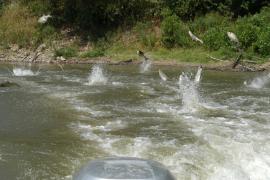
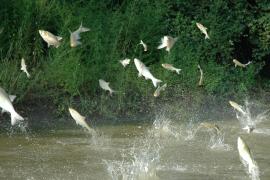
Asian carp are renowned for their ability to jump as high as 10 feet and potentially injure boaters. While many folks find this alarming, the threats to habitat and water quality are also very serious. Asian carp are large planktivores, eating copious amounts of small organisms, toppling the food chain and out-competing native fish species. In addition, they are bottom feeders that stir up sediment, which adds to river turbidity, one of the biggest water quality impairments on the Mississippi River in Minnesota.
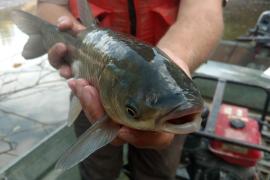
The eDNA study, which was funded by the Mississippi River Fund and the St. Croix River Association, consisted of collecting samples from two river locations – the St. Croix River just below the dam at St. Croix Falls and on the Mississippi River just below Lock and Dam #1 (Ford Dam). Out of 50 samples collected on the St. Croix, 22 tested positive for DNA from silver carp. None of the 50 samples taken on the Mississippi River were positive, although researchers noted that the river was at flood stage during the sampling, which could have skewed the results. Both sites tested negative for two other Asian carp species, black carp and bighead carp, although one bighead carp was caught at the mouth of the St. Croix in April of this year.
“This study is a wakeup call for everyone who cares about water quality, fish habitat and Minnesota's recreation economy." said Whitney Clark, FMR Executive Director. "Now is the time to get serious about researching, funding and deploying redundant barriers to prevent this harmful species from invading the Mississippi River and its watershed."
Quick action is clearly needed, but there are many layers of government that are responsible for managing the river, and it could take some time to finalize and implement a plan that everyone can agree upon. A task force of government agencies, that was pulled together by the National Park Service in January, is attempting to put an action plan together as quickly as possible. Some of the possible strategies include experimental techniques, such as a bubble or acoustic barrier inside a lock chamber, improvements to dams to prevent fish passage, temporary closure of some locks, and even permanent lock closure. Additional research and monitoring is also needed, both on the fish populations in Minnesota and some of the emerging techniques and technologies.
None of this is likely to add up to fast action, but we need to push for as much expediency as possible. FMR is working with a coalition of non-government groups in Minnesota and other Great Lakes states to track the progress of government agencies, help educate the public, and advocate for specific short and long term actions.
In the mean time, there are a few things you can do to help:
For more information, please email Irene Jones, FMR's river corridor program director via our contact form or by phone at 651/222-2193 ext. 11.
This issue is all over the news – it even made it into the Wall Street Journal. Below are a few links to local coverage on the Asian carp issue.