Working to protect the Mississippi River and its watershed in the Twin Cities area
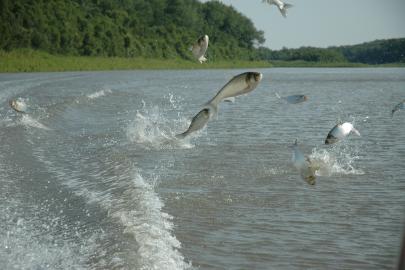
Asian carp detected in the Mississippi River in Minnesota thus far could be "pioneers" — fish that head upstream in search of new habitat. Pioneers have also been found on the Missouri River as far north as South Dakota.
Photo: A. Muir/GLFC
Test results released last month ratcheted up the volume on calls to address the issue of Asian carp invading the Mississippi River in Minnesota. Using a relatively new aquatic species monitoring protocol, environmental DNA or eDNA, genetic material from Asian carp was detected in 28 percent of samples collected just downstream from Lock and Dam 1, the Ford dam, presenting further evidence that the dreaded fish is making its way up the Mississippi River into the Twin Cities.
Although eDNA testing earlier this year showed evidence of Asian carp in the St. Croix but not the Mississippi River, National Park Service representatives were not surprised. This summer's high waters may have skewed previous sampling. Additional eDNA results are expected soon from the Mississippi River just upstream of the Coon Rapids Dam, the Minnesota River near Fort Snelling and several St. Croix locations.
Efforts are also underway to catch an Asian carp, but none have turned up in any of the eDNA-positive waters thus far. However, Asian carp are elusive and difficult to catch — a live fish may not turn up in any of the nets until it's too late to stop their population from exploding. Clearly, the fish are present, but likely in very small numbers for the time being.
Asian carp in Minnesota could be "pioneers" — fish that head upstream in search of new habitat. Each of the four species of Asian carp (bighead, silver, black and grass) has an identified "Invasion Front," the location on the Mississippi River where the population has exploded and become difficult, if not impossible, to control. Presently, only the black carp invasion front is south of the Iowa-Illinois border; the other fronts get closer every day.
In response to this pressing problem, Governor Dayton has called for another Asian carp summit before Thanksgiving. Members of Minnesota's congressional delegation, other elected leaders, state and federal agency representatives and interested organizations have been invited to discuss and collaborate on quick action. One potential solution getting considerable attention is the temporary or even permanent closure of Lock and Dam 1 (the Ford dam) and the St. Anthony Falls Upper Lock in downtown Minneapolis. If that happens, recreational boaters will need to alter their routes while commercial navigation will altogether cease in Pool 1.
"There would be economic and recreation impacts to closing the locks," said FMR Executive Director Whitney Clark, "But it might be the only absolute way we can prevent Asian carp from moving upstream of the Twin Cities, where they would cause far greater damage to the Mississippi's ecology and many of the state's treasured fishing and recreational lakes and rivers."
FMR is keeping a close eye on this important issue. Watch for updates in Mississippi Messages on forthcoming eDNA test results, Governor's summit action plan efforts and how you can help.
For more information on this issue in general, please contact Irene Jones, FMR's River Corridor Program Director at 651-222-2193 ext. 11 via our contact form.
In the news:
Previous FMR carp updates: